

Piratech Slippy Kráki



€299.00*
Oh NO - I am not in stock right now! 😞
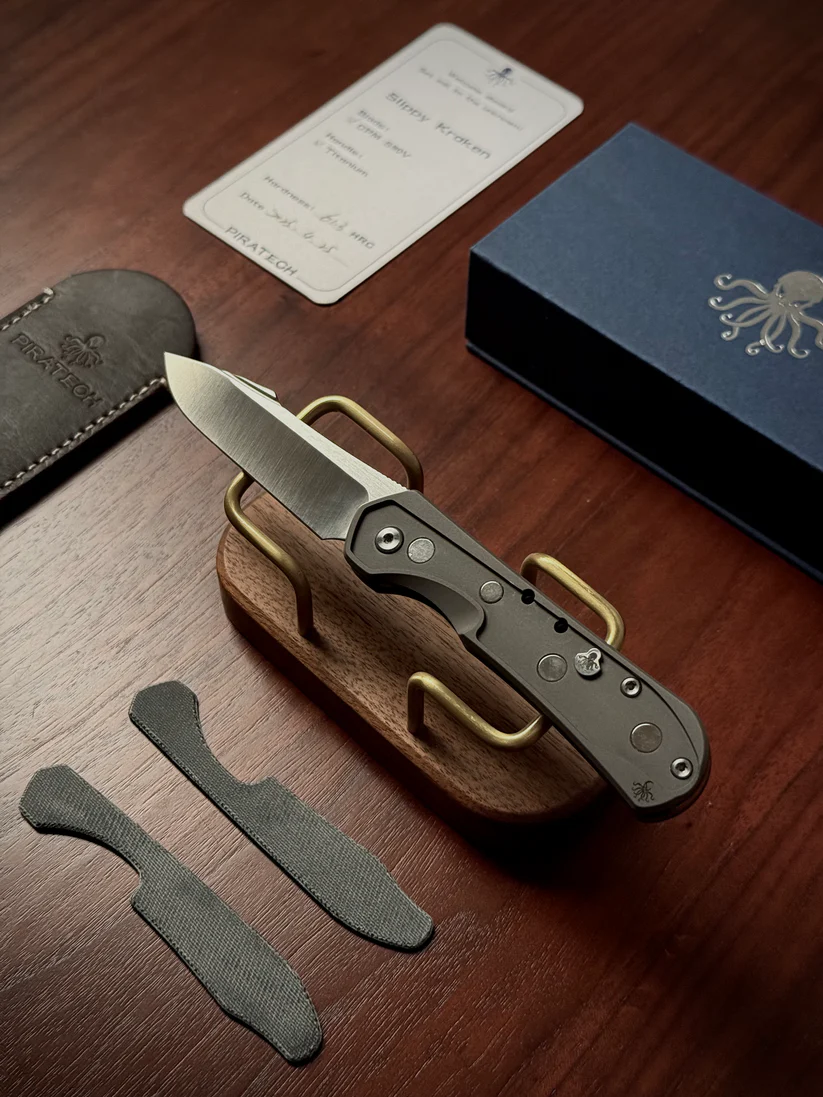
A slipjoint done right. The Slippy Kraken combines smart design, everyday legality, and real cutting performance. Minimalist, modern, and ready for your pocket.
Piratech Slippy Kraken – The Slipjoint, Reimagined
The Slippy Kraken isn’t a throwback to old-school knives – it’s a bold redesign. Piratech has taken the slipjoint concept, broken it down, and rebuilt it with modern tech and clever engineering. The result is a knife that’s legal to carry in most parts of Germany – and still plays in the top league when it comes to materials and function.
This isn’t the knife you carry just because you have to. This is the one you want to carry.
Tool-free inlay swapping with MagSnap
Thanks to a magnetic mechanism, the inlays stay rock-solid during use but can be changed in seconds – no tools, no hassle. Ideal if you like switching things up from time to time.
Recurved backspring meets ergonomic design
The spring is reverse-tensioned – sounds weird, feels great. This construction allows for a naturally curved handle without sacrificing mechanical stability. It fits your hand like it was made just for you.
118-degree mid-stop – smarter than the standard
Most slipjoints stop at 90 degrees. Sounds fine, but in practice it puts your fingers at risk. The Slippy Kraken uses a 118° stop, meaning the blade is further away from your fingers if it ever starts to close unintentionally. Small detail, big safety bonus – especially when applying thumb pressure or during closing.
Spring tension adjustment – your knife, your feel
Crisp and snappy or smooth and easy? You decide. The backspring tension is fully adjustable, giving you total control over the action.
Compact spring, more usable blade
Because of the smart internal design, more space is available for the blade. You’re getting full performance in a slipjoint-friendly format – no compromises necessary.
The Slippy Kraken isn’t a backup solution. It’s proof that a slipjoint can be modern, capable, and completely ready for daily carry – with no trade-offs in design, feel, or function.
| Blade length: | 7,3 |
|---|---|
| Blade material: | CPM S90V |
| Blade runs on: | Bearings |
| Blade thickness: | 2,8 |
| Clip: | No |
| Closed Length: | 9,9 |
| Grinding: | Hollow |
| Handle Material: | Micarta, Titanium |
| Knife type: | Every Day Carry |
| Legal to carry in Germany: | Yes |
| Locking Mechanism: | Slip Joint |
| Overall Length: | 17,2 |
| Weight: | 81 |
Login
⚠️ Safety Information for Neodymium Magnets
Crushing hazard
These magnets attract each other at high speed and can pinch skin or fingers. Injuries such as bruises or fractures are possible. Handle with care.Strong magnetic force
Uncontrolled collisions between magnets or with metal objects can cause damage or splintering. Broken magnets may have sharp edges. Wearing protective gloves is recommended.Not a toy
Neodymium magnets are not toys. Swallowed magnets can be life-threatening, as they may attract each other inside the body and cause serious internal injuries. Keep out of reach of children at all times.Electronic devices
Strong magnetic fields can interfere with or damage electronic devices such as smartphones, credit cards, hard drives, or pacemakers. Maintain a safe distance of at least 20 cm from such devices.Fire and explosion hazard
Magnets must not be machined, drilled, or cut, as they may splinter or ignite. High temperatures (above 80 °C) can permanently reduce their magnetic strength.Temperature resistance
Standard neodymium magnets are not resistant to high temperatures. Do not store them near ovens, heaters, or in direct sunlight.Warning / Safety Notice:
Risk of cuts: The most common hazard when using knives is the risk of cuts. Sharp blades can easily penetrate skin and tissue.
Blade slippage: Improper handling or applying excessive force may cause the knife to slip, leading to uncontrolled movements and potential injury.
Injuries from falling knives: Knives should never be left unsecured or placed near the edge of tables or work surfaces, as they may fall and cause injury.
Dull blades: Dull knives pose a higher risk of injury, as they require more force and are more likely to slip. Knives should therefore be sharpened regularly and properly.
Improper use: Using a knife for purposes other than its intended use (e.g. as a prying tool) can damage the blade and may result in accidents.